Many U.S. traders still think of centralized exchanges as simple order books and custody services. That view misses an important shift: OKX blends a full-featured centralized exchange with Web3 primitives — a non-custodial wallet, DEX aggregation, staking, and a DeFi hub — inside one product. That hybridization matters because it changes the levers available to traders: custody choices, routing for best execution, and where counterparty risk sits. Understanding those mechanisms clarifies what OKX offers, where it can fail, and how to decide whether to log in and trade there today.
The opening correction — that OKX is both a CEX and a Web3 suite — sets the frame for the practical, decision-focused analysis that follows. I’ll use a short US-based trader case to expose mechanisms, trade-offs, and clear heuristics for when to use spot, margin, futures, staking, or the Web3 wallet. I will also show what to watch next, including a recent operational step: this week the platform removed several low-volume spot pairs as part of routine housekeeping — a small signal with useful implications for liquidity risk management.
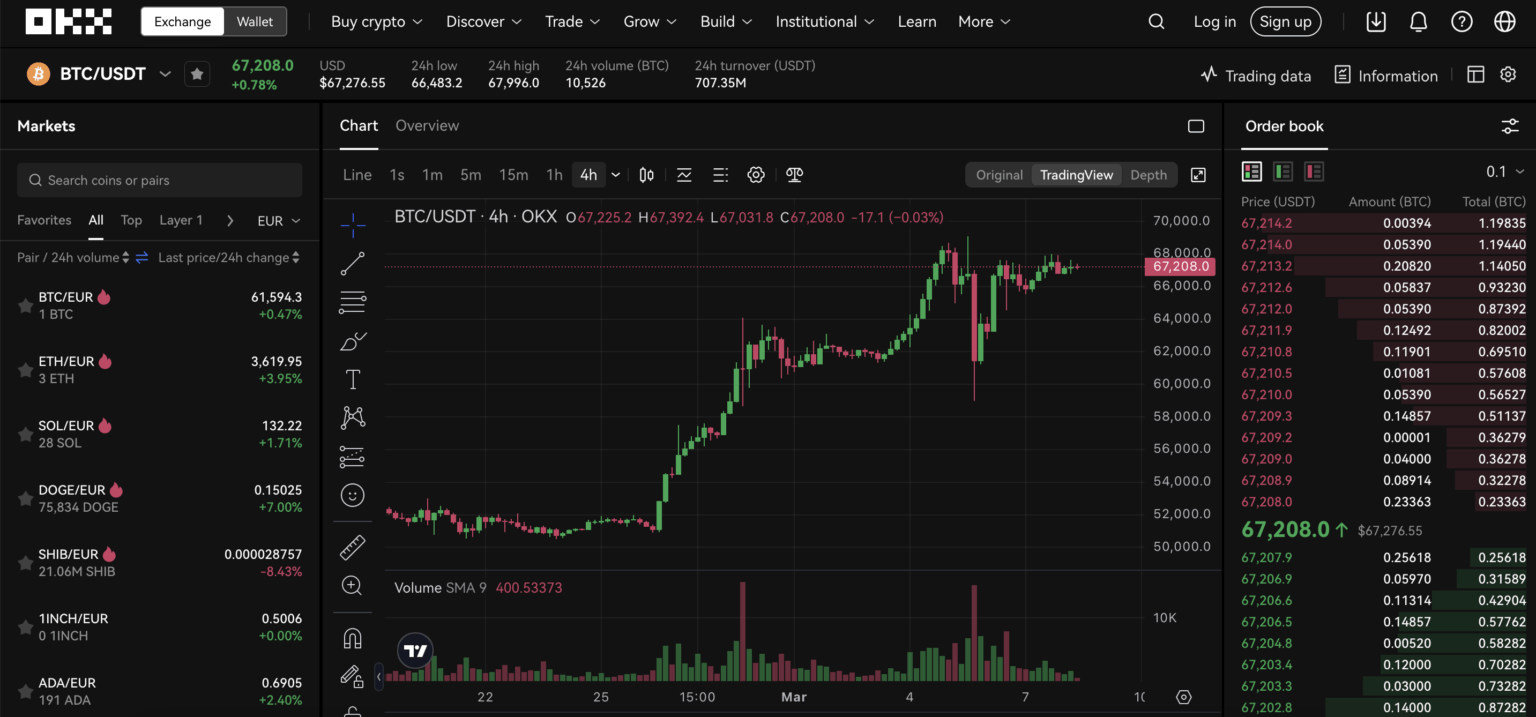
Case scenario: an informed US trader deciding where to execute — spot, margin, or futures?
Meet the trader: US-resident, moderate experience, portfolio concentrated in BTC and ETH, occasional interest in DeFi tokens, values security and predictable fees. The practical choice tree they face is: 1) use OKX spot for simple buy/sell; 2) add margin for leverage up to 10x; 3) enter futures/perpetuals for directional leverage up to 125x on some products; or 4) move assets into the OKX Web3 wallet for non-custodial DeFi strategies and staking.
Mechanism matters. Spot trading on OKX executes against a centralized order book; price discovery is immediate, matching taker and maker orders against visible liquidity. Margin trading layers borrowing against your spot holdings: you get larger exposure but accept liquidation mechanics and interest costs. Futures/perpetuals separate price exposure from spot ownership and often let traders use much higher leverage (perpetuals can go up to 125x on some assets). That high leverage increases profit potential but sharply raises the chance of rapid margin calls and liquidation in volatile US-market sessions — a mechanical risk, not an abstract one.
Decision heuristic: if your horizon is tactical rebalancing or accumulating spot exposure, stick with spot or low leverage margin (1–3x). If you are arbitraging funding rates or hedging a portfolio, consider futures but keep position size rules (e.g., never risk more than 1–2% of equity on any single highly leveraged trade). The platform provides both isolated and cross-margin modes — isolated contains risk to a single position; cross shares collateral across positions. Use isolated when you want predictable failure boundaries; use cross only if you actively manage correlated positions and understand the contagion risk.
Spot trading and liquidity: the practical mechanics and limits
OKX supports over 300 cryptocurrencies and a wide range of stablecoins. That breadth helps traders access niche opportunities, but it also creates variability in liquidity. The platform’s recent delisting of low-volume pairs (RSS3, MemeFi, GHST, RIO, SWEAT) is routine housekeeping that underscores the core point: not all listings provide reliable execution. When liquidity thins, slippage and wide bid-ask spreads appear mechanically — market orders turn expensive, limit orders sit unfilled.
Mechanism-first rule: always check the order book depth for the pair and the 24-hour traded volume before using market orders. For spot trades above a certain amount (your own threshold, often 1–5% of 24h volume), use limit orders or split execution. For U.S.-based traders, regulatory constraints can influence pair availability and KYC turnaround times; OKX requires KYC with ID and facial liveness checks, which affects how quickly you can move from signup to execution.
Futures and derivatives: power and the hidden fragility
Futures on OKX — including quarterly contracts, perpetual swaps, and options — let traders take pure directional exposure and implement sophisticated hedges. The exchange offers up to 125x leverage for certain instruments, which is attractive but dangerous. The critical mechanism to understand is the maintenance margin and the liquidation ladder: leverage amplifies both position size and sensitivity to price moves, while funding rates and insurance funds buffer systemic stress but can be depleted during correlated liquidations.
For a U.S. trader: high leverage should be treated as a tool for specific, time-bound strategies (e.g., short-lived directional bets or hedges), not a default way to trade. Margin requirements change with volatility and liquidity; the exchange can change maintenance margins intraday. That means your apparent free collateral can evaporate quickly when volatility spikes, producing forced liquidations. Practical rule: size futures positions so a normal volatility event (e.g., a 5–10% intraday move for altcoins, 2–5% for BTC/ETH) does not immediately trigger margin calls.
Web3 wallet, staking, and the custody choice
OKX’s non-custodial Web3 wallet is a structural alternative to keeping assets on the exchange. Mechanism: with the Web3 wallet you control seed phrases and private keys; with the exchange account you delegate custody to OKX. Each has distinct risk vectors. Custody on OKX benefits from centralized protections — the exchange keeps over 95% of assets in multi-signature cold storage and offers Proof of Reserves for transparency — reducing the risk of large-scale hot-wallet thefts. But centralized custody concentrates counterparty risk: the exchange is a single point of failure for withdrawals, regulatory constraints, or operational outages.
In contrast, the non-custodial wallet removes counterparty risk but introduces human and smart-contract risk: losing a seed phrase is irreversible; interacting with DeFi protocols opens exposure to smart contract exploits. OKX’s wallet supports hardware integrations (Ledger, Trezor), which is a strong middle path: use hardware keys for long-term holdings, keep a small hot-custody balance for trading, and segregate funds by purpose.
Staking and yield: OKX offers flexible staking, fixed-term lock-ups, and DeFi yield farming with auto-compounding. Mechanically, staking converts liquid assets into protocol-level exposure that yields rewards but may impose lock-up or slashing risk depending on the chain. For U.S. taxpayers, staking rewards are taxable on receipt, and lock-ups complicate tax planning. The heuristic: stake only amounts you can tolerate being illiquid through potential drawdowns or tax events.
Security, login, and the practical login workflow
Account protection on OKX uses military-grade encryption, 2FA (SMS, Google Authenticator, biometrics), and AI-driven detection. For U.S. traders, enable hardware-backed 2FA and biometric login on mobile to reduce phishing risk. If you plan to switch frequently between the CEX and the Web3 wallet, be mindful of phishing vectors that clone login pages. Always verify domain and certificate, and consider bookmarking the verified login flow.
For traders ready to start or resume trading after KYC, a useful first step is to register and complete identity verification early so you’re not blocked in a volatile window. The platform’s integrated tooling makes it possible to move between spot, margin, futures, and Web3 interactions, but each step involves different permissions and risk boundaries. When logging in, a practical checklist: 1) confirm KYC status; 2) enable 2FA; 3) review proof-of-reserves statements if concerned about systemic custody backing; 4) test small transfers between CEX and Web3 wallet to validate addresses and chains.
When you’re ready, use this link to access the official login guidance and get started: okx sign in.
Where the system breaks — limits and unresolved issues
Three boundary conditions deserve explicit attention. First, liquidity for many tokens is fragile: delistings are a blunt instrument to protect users and the market, but they can strand holders of small tokens. Second, DeFi integrations open smart-contract risk that the centralized exchange’s cold storage cannot mitigate; Proof of Reserves does not protect assets you bridged into third-party protocols. Third, regulation — particularly in the U.S. — remains a wildcard: KYC/AML requirements and regional product availability can change access or product offerings faster than most traders expect. These are not abstract: they determine whether a strategy that looks good on a chart is actually executable.
Experts broadly agree on the mechanisms above but debate optimal custody mixes and leverage practices. The unsettled policy environment means the safest operational posture is a disciplined separation of roles: custody for long-term savings (prefer hardware + non-custodial control), trading balance for active strategies (regulated CEX with cold-storage assurances), and experimental capital for DeFi farming — keep that portion small and easily replaceable.
Practical takeaways and a reusable decision framework
One sharpened mental model to keep: think in three buckets — custody, execution, and experimentation. Custody = where you store long-term value (prefer cold, hardware-backed non-custodial or segregated exchange cold storage). Execution = where you need fast, liquid access for order flow (spot/margin on a CEX). Experimentation = DeFi, yield farming, NFT activity in Web3 wallets. Assign each asset class and each portion of your capital to one bucket and avoid mixing purposes in a single address or account.
Heuristic trade rules: limit order for spot above 0.5% of 24h volume; isolated margin for single, speculative bets; capped leverage with strict stop protocols for futures; hardware key + small hot-custody for active trades; and only stake what you can comfortably leave illiquid for the duration of the lock-up. Monitor funding rates, order book depth, and recent delisting activity as near-term signals of liquidity shifts.
FAQ
Is OKX safe for U.S. traders?
“Safe” is relative. OKX uses best-practice cold storage and Proof of Reserves for transparency, and it enforces KYC/2FA. Those reduce some systemic risks, but U.S. traders still face regulatory uncertainties, phishing, and smart-contract risks when using Web3 features. Treat safety as layered: platform controls + your custody choices + operational hygiene (2FA, hardware wallets, careful link verification).
Should I use OKX’s Web3 wallet or keep everything on the exchange?
Use both, for different reasons. The exchange is practical for trading and benefits from institutional-grade custody; the Web3 wallet is appropriate for trust-minimized interactions, hardware integration, and experiments in DeFi. A hybrid approach — hardware-backed non-custodial storage for core holdings, small exchange balance for execution, and a segregated wallet for experimental yield — balances convenience and risk.
How do the recent delistings affect me?
Delistings typically target low-liquidity pairs to protect market integrity. If you hold tokens in delisted pairs, check withdrawal and conversion windows; the practical risk is temporary illiquidity or higher exit costs. The delistings are a signal to prioritize liquid markets and to avoid concentrating capital in obscure tokens unless you accept the execution risk.
What’s the simplest rule for leverage on OKX?
Keep it low unless you have a specific, time-bound strategy. For most retail traders, 1–3x on margin and conservative use of futures is sufficient. If you use higher leverage, size positions so that routine volatility doesn’t trigger a cascade of margin calls.